AI Writes the Code in Seconds. Security Still Takes Weeks — Here's How to Close That Gap
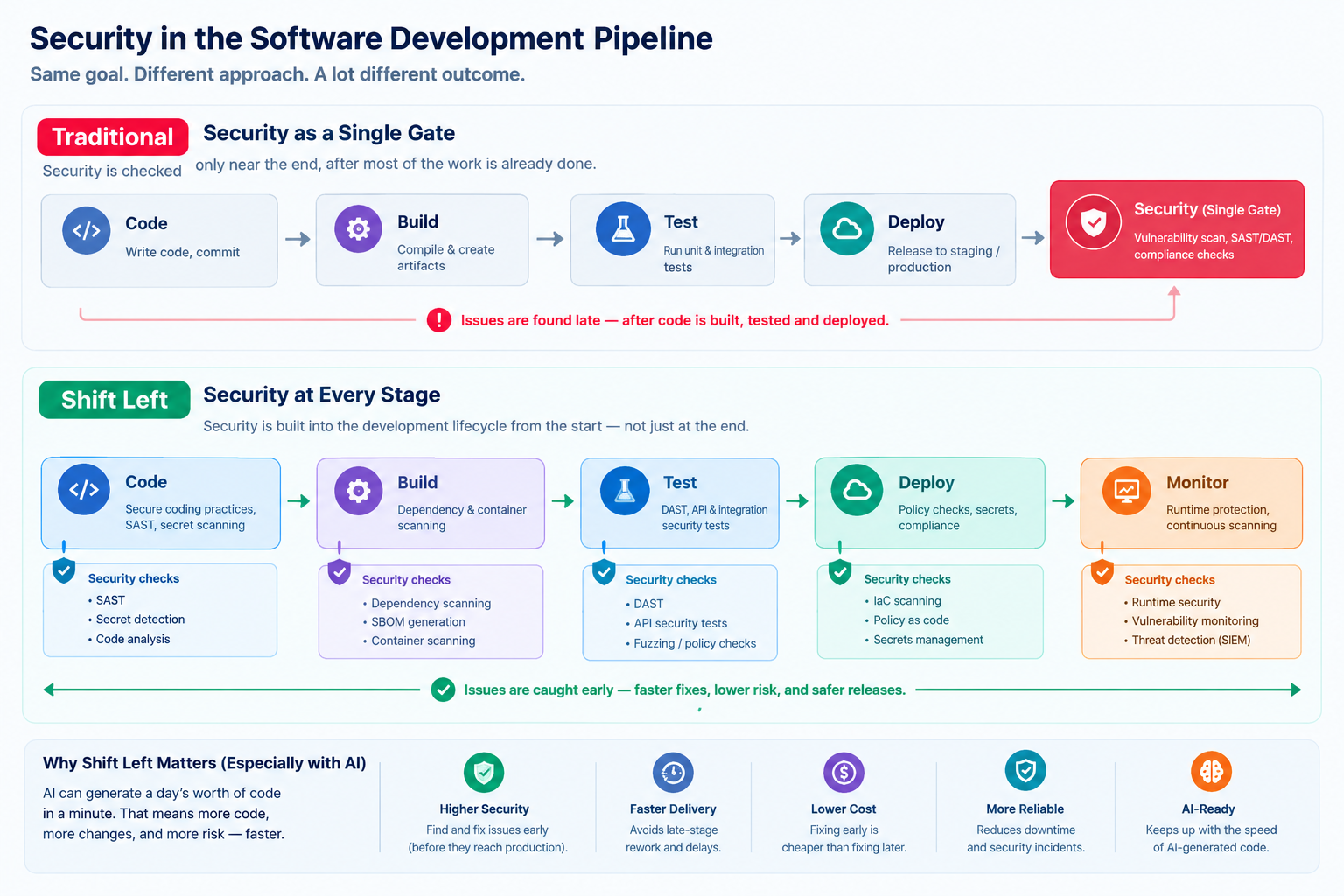
AI is changing software development faster than any technology shift in decades. Forty years ago, writing code was manual, slow, and error-prone. Today, developers generate code, tests, agents, and multi-step workflows from a single prompt.
That's a genuine step change. But it introduces a hard problem: security practices designed for human-written code and slower development cycles do not automatically scale to AI-assisted development. If security only happens at the end, as a retrofit, quality suffers and the whole pipeline grinds to a halt.
The fix is to shift left — start security at the earliest stages of development and carry it through the entire lifecycle. In the AI era this isn't just "run the same tools earlier." It's a change in what you validate, when you validate it, and how you build confidence in a solution you didn't type yourself.
Here are five practices worth building into your workflow, plus a look at where AI-assisted code review tools like CodeRabbit fit in.
Trust the outcome, not the generation
Security starts during development
Scrutinize AI-introduced dependencies
Validate intent, not just syntax
Treat security as ongoing, not a milestone
1. Trust the Outcome, Not Just the Generation
AI-generated code does not equal trusted code. One of the most deceptive things about it is that it often looks correct. It compiles, it runs smoothly, it might even pass your standard tests. That's a false sense of security.
A block of code can hide real risk under a clean surface. Before you merge it, ask:
- Does the system fail safe, or does it fail into an open, dangerous state?
- Are there potential data leaks?
- How are permissions actually being handled — not how you assumed they'd be handled?
Take a concrete case: an AI-generated service correctly retrieves customer information from a database. Correctly, in the sense that it returns the right rows. But should it really have access to every column in that table? Could sensitive data be exfiltrated through it? What happens when authentication fails, or malformed input hits the query? "It works" and "it's secure" are two different claims — validate both.
2. Security Starts During Development — No More End-of-Line Checkboxes
Security used to be an afterthought: code gets written, components get built and tested, code gets committed, and then the security review happens — a checkbox at the end of the line. That model never worked especially well, and it fully breaks down in an AI-assisted environment.
The earlier a bug is found, the cheaper it is to fix. A bug caught in production is expensive; the same bug caught during development is cheap. When AI can generate code in seconds, waiting until the end to check it creates a bottleneck and increases risk at the same time — the worst of both.
Shifting left means embedding validation directly into the process while code is being created, not after — and it means a different set of checks at every single stage of the pipeline, not one big scan at the end:
Code
- SAST
- Secret detection
- Code analysis
Build
- Dependency scanning
- SBOM generation
- Container scanning
Test
- DAST
- API security tests
- Fuzzing / policy checks
Deploy
- IaC scanning
- Policy as code
- Secrets management
Monitor
- Runtime security
- Vulnerability monitoring
- Threat detection (SIEM)
> A minimal shift-left CI job — runs on every pull request, not at release time

name: security-gate
on: [pull_request]
jobs:
  scan:
    runs-on: ubuntu-latest
    steps:
      - uses: actions/checkout@v4
      - name: Secret scan
        run: gitleaks detect --source . --no-git -v
      - name: Static analysis (SAST)
        run: semgrep ci
      - name: Dependency / SCA scan
        run: npm audit --audit-level=high
Why shift left matters, especially with AI AI can generate a day's worth of code in a minute. That means more code, more changes, and more risk — faster than any manual review process can absorb.
Higher security
Find and fix issues early, before they reach production.
Faster delivery
Avoids late-stage rework and delays.
Lower cost
Fixing early is cheaper than fixing later.
More reliable
Reduces downtime and security incidents.
AI-ready
Keeps up with the speed of AI-generated code.
3. Scrutinize the Dependencies AI Introduces
Here's a reality worth sitting with: AI doesn't just create code, it introduces dependencies. Through the "miracles of AI," a generated solution will quietly pull in new packages, libraries, services, and integrations under the hood.
Every dependency adds capability — good. Every dependency also adds risk — not so good. Developers tend to scrutinize the generated source intensely while completely overlooking what that code now depends on. Out of sight, out of mind.
Most modern security incidents originate in the software supply chain, not in application logic. Generated dependencies deserve the exact same scrutiny as generated code. Validate:
- Package reputation and maintenance activity
- Known vulnerabilities (CVEs) in the resolved version, not just the latest one
- Licensing restrictions
- Source integrity against your organization's approved registries
4. Validate Intent, Not Just Syntax
This may be the most important shift of all. Many serious security issues aren't caused by bad coding — they're caused by incorrect assumptions. A model can generate code that's technically elegant and follows every best practice, and still violate a core security policy, because it misunderstood the business requirement.
The King Midas problem In Greek mythology, King Midas wished that everything he touched would turn to gold. He got exactly what he asked for — and nearly starved, because you can't eat gold. AI works the same way: a generated workflow might correctly process financial data while simultaneously exposing it to users who should never see it. That's an intent problem, not a coding problem.
Reviewing AI output is no longer just reviewing code quality — it's reviewing whether the AI solved the right problem, the right way. Explicitly define and validate: who should access which data, what actions are permitted, and which business rules apply, before you accept the implementation.
5. Security Is an Ongoing Practice
Organizations have historically concentrated security work near release day. AI-assisted development produces continuous change, so validation has to be continuous too — including well after release.
Every stage of Develop → Test → Deploy → Monitor → Improve needs its own security validation. To make that real, teams need continuous vulnerability detection, continuous dependency monitoring and patching, and persistent policy verification — not one-time checks. The question isn't just "did it pass once?" It's "does it continue to pass?"
Frontier AI models have recently been used to discover zero-day vulnerabilities in open-source software that had gone unnoticed for decades. The lesson holds regardless of the exact number: security is never done. It's a living part of the process that evolves alongside the software.
Where a tool like CodeRabbit fits in
Most of the practices above sound reasonable and still don't happen, because they require someone to remember to run a scanner, or to read a 400-line AI-generated diff line by line before approving it. The practical fix is to put an AI reviewer directly in the pull-request path, so security review happens automatically, on every change, without becoming a manual gate.
CodeRabbit is one example of this category: it installs as a GitHub/GitLab/Bitbucket app and automatically reviews every pull request — including ones written largely by AI. In practice that looks like:
- A plain-language summary of what the PR actually changes and why, before you read a single line
- Line-by-line comments that flag likely bugs, logic errors, and security-relevant issues directly in the diff
- Awareness of your repo's conventions, so feedback is contextual rather than generic linting
- A chat interface on the PR, so you can ask "why is this flagged?" or "suggest a fix" without leaving GitHub
It doesn't replace practices 1–5 above — it's the mechanism that makes them actually happen on every PR instead of only when someone remembers to look. That's the whole point of shifting left: validation that runs by default, not validation that depends on discipline.
Visit coderabbit.ai →The Next Frontier: Securing Agentic AI
As AI becomes more agentic, it performs multi-step work across connected services, repositories, pipelines, and configurations. At that point, reviewing individual files stops being enough — the hardest security problems aren't in a single function, they're in the unintended consequences that show up across connected systems.
Guardrails
Clear, enforced rules on what an agent can and cannot do.
Identities
Agents need accountable identities, so actions can be traced to who — or what — did them, and why.
Access controls
Strict, scoped limits on capability, so an agent can't reach systems it was never meant to touch.
Human-in-the-loop
Continuous oversight from real developers — not a one-time approval at the start.
Watch the original talk
This article expands on ideas from IBM Technology's video on securing AI-generated code — worth watching in full: youtube.com/watch?v=X0UI0O8YzJM
Conclusion
AI lets teams generate more code in a minute than they used to write in a day. More code means more functionality — but also more complexity, and complexity is the enemy of security.
Speed alone doesn't create value. Trust does. The teams that do well in the AI era will be the ones that embed security directly into everyday development workflows, rather than bolting it on afterward. The goal isn't just to review code anymore — it's to confidently verify outcomes across a fast-growing codebase, faster than the codebase is growing.